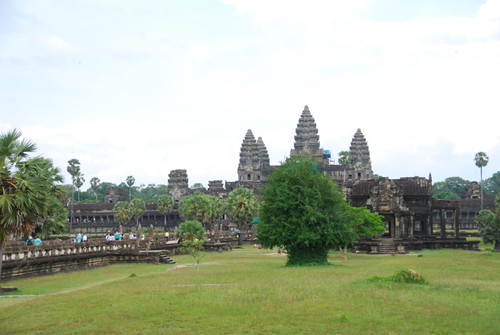
Angkor Wat!
Our second day in Siem Reap was possibly the fullest day we have had yet on this trip. It began from the previous evening, when we took a tuk-tuk to Angkor Wat to pre-purchase the next day’s ticket for admission. We then got to watch sunset at Phnom Bakheng, one of the temples situated on a hill, before tucking into bed early for the next day.
Our tour of the temple complex began at 4AM, when I woke with a start to realize that the alarm failed me 15 minutes ago. Stuffing ourselves with toast that the hotel had set out, we were in our tuk-tuk by 4:20AM, on our way to Banteay Srei, 37km outside of the main temple complex.
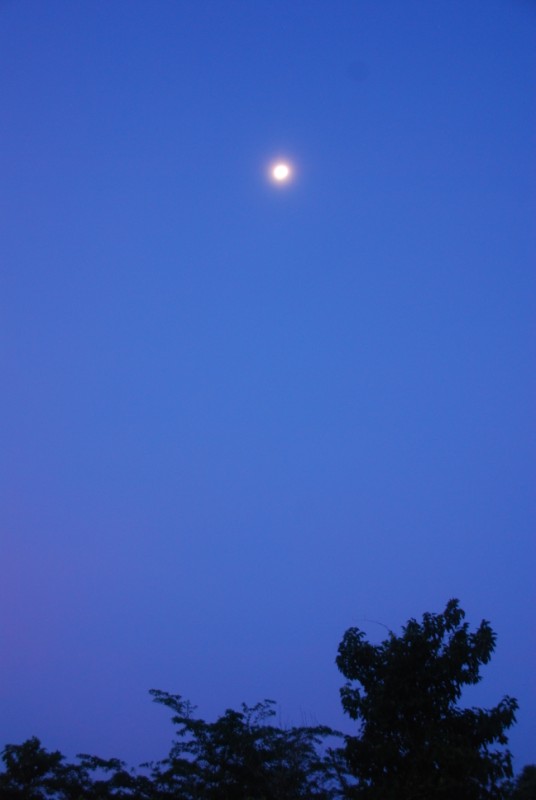
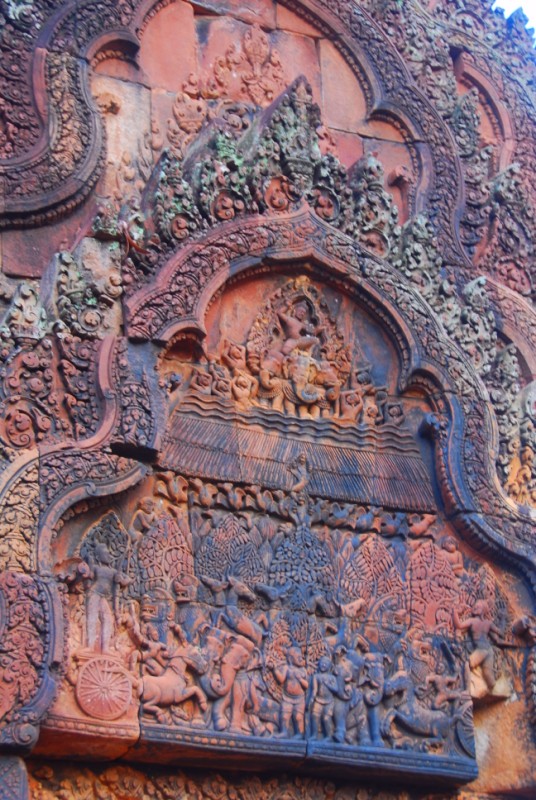
Not kidding, the moon was still out. The detail and beauty of the Banteay Srei made up for lack of sleep, though!
Banteay Srei is one of the smallest temples in the Angkor complex, and one of the most delicate. Constructed most differently with pinkish stone, it shone with a quiet but majestic brilliance in the early morning light. As the sun made its way up, the stones were slowly changing colour as well, going from a deep mauve hue to a light golden pink by the time we left, an hour later. We were a group of four, and the only four there, aside from some random locals and a ticket controller. As a side note, all of the said others tried to get us to pay them money so we could enter the areas that were blocked off. We think the locals just show up early to trick tourists (there’s dedication in trying to make a few bucks, though!) and the ticket controller was just sketch. Oh, and a fake security guard was there too, and he tried to sell us his badge for $5. Seriously, these people are so money-scheming that I didn’t know whether to laugh or cry at the absurdity so early in the morning.
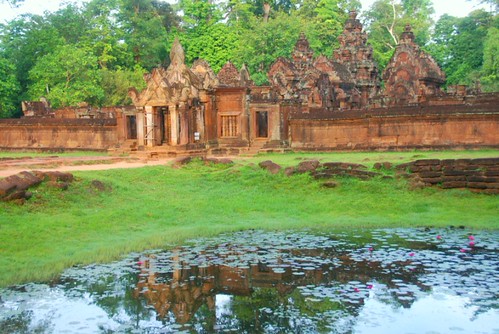
Banteay Srei, early in the morning
From Banteay Srei, we made our way down to the main Angkor complex, stopping at
- Eastern Mebon – a 10th C. temple built to honour the king’s parents, and dedicated to Shiva. It has landings that were formerly docks, and in ancient times it was situated in the middle of water, a gesture that definitely represented respect as Angkor was a land often plagued by draught
- Pre Rup – just down the road from the Eastern Mebon, very similar in style and architecture. Pre Rup means “turn the body”, and it was built for funerary purposes, with chimneys and access to water for cremation after death (i.e. the “turning of the body”)
- Banteay Kdei – although not one of the larger temples, the entrance was pretty prominent and caught our attention. It is a Buddhist temple, but since no real inscriptions were found in the recovery process, the purpose and dedication of the temple are still unknown.
- Ta Prohm – the temple most famously known because of Tomb Raider. It is a temple dedicated to the king’s mother, and it is largely shaded by trees that have grown to be a part of the temple – literally. Everywhere, trees and stones are struggling for control, and it was neat to see tree trunks taking over the large stone structure. Apparently maintenance of this temple is the hardest as the team tries to preserve the tree-temple battle, without killing trees or damaging the temple further.
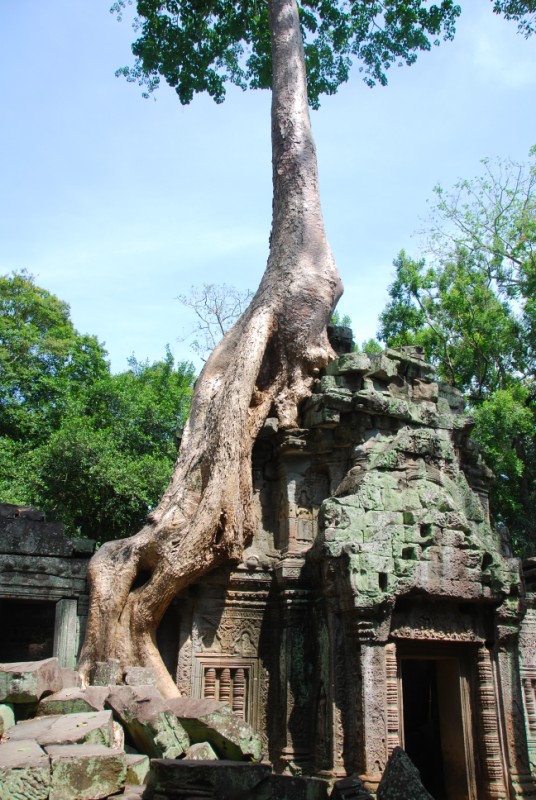
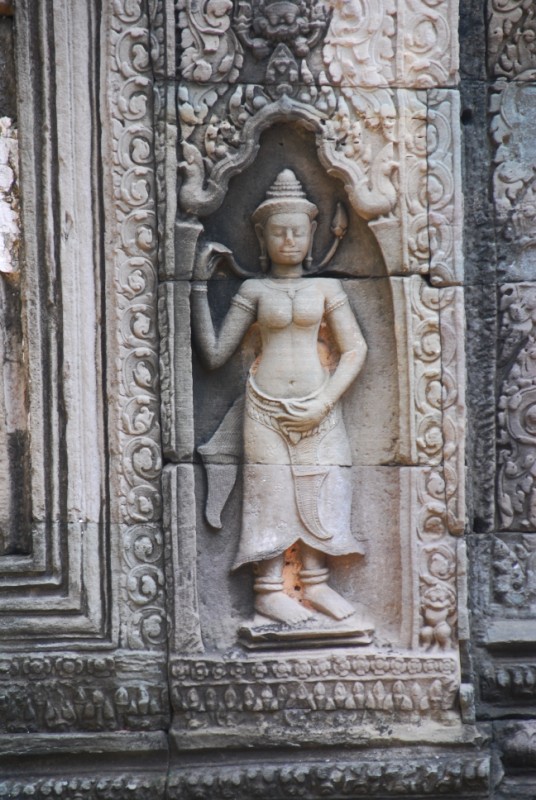
The battle between tree and temple. One of the apsara protecting the temple.
- Preah Kahn – the temple dedicated to the king’s father, and also once used as a Buddhist university for teaching. This temple felt much more flat and open, and the sculptures and carvings, compared to Ta Prohm, were much more masculine
- Baphoun, Bayon – all considered as part of the Angkor Thom complex, which was the capital city of the Khmer Empire back in the day. The main temple, the Bayon, is known also as an architectural style in the Angkor complex. It was huge, and featured 216 faces carved into pillars all around the three main tiers of the temple. Speculation is that the faces resemble the king who commissioned it, more than any gods the temple to whom the temple may be dedicated
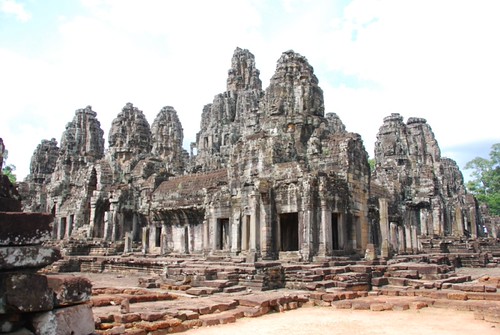
The Bayon at Angkor Thom
- Angkor Wat – by the time we got here, we were super hot, exhausted, and kind of templed-out. Angkor Wat didn’t cease to amaze in size and layout, though. It is the best preserved in terms of the grounds as well, with lush green grass everywhere, and the moat still flowing with water (it is the main river through the complex, after all). We climbed up to the top to take in the views, but also walked all the way around to see the bas-relief carvings on all the sides of the wall, depicting different stories from holy scriptures such as the fight between good and evil. The wall carvings were most impressive since they covered 800m worth of walls all around!
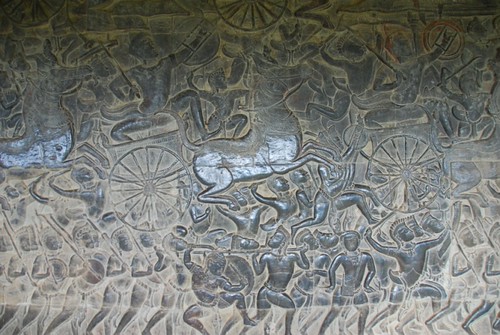
The bas-relief detail on the walls outside Angkor Wat
After a whirlwind of a tour, we got back to our hotel at 5PM, showered quickly (free of charge because the Golden Mango Inn was that awesome), and got ready to board our night bus to Ho Chi Minh City. Into Vietnam we went!